

2025 Review: when the market changes, those who build a system—not just a service—win
A decade ago, it was necessary to explain why used cooking oil was worth collecting at all. In 2025, the situation is very different—today, businesses no longer ask “why,” they choose “with whom.” And that means one thing: the used oil collection market in the Baltic states has entered a stage of maturity. Competition is growing, regulation is becoming stricter, and the feedstock is becoming increasingly valuable. In this context, Biomotorai is demonstrating steady growth—not by chance, but because of a deliberately built system.

Used cooking oil has become a strategic feedstock—not waste
In 2025, the biofuels market gained a clear growth trajectory. This was driven not only by economic factors, but also by increasingly strong European Union regulation. According to Donatas Karanauskas, head of the “Biomotorai” group of companies, the change is systemic:
“By 2030, the European Union aims for as much as 29% of transport energy to come from renewable sources. Electric vehicles alone will not be enough—biofuels will account for a significant share of this change. In this context, used cooking oil is becoming one of the most important feedstocks, enabling fuel suppliers to reduce emissions more quickly. In Lithuania, Latvia, and Estonia, diesel currently contains biodiesel blends of up to 7%. However, in order to meet EU targets in the transport sector, the importance of biofuels and the scale of their use will inevitably grow in the coming years,” says D. Karanauskas.
The importance of used oil is growing especially beyond the boundaries of traditional road transport. It is becoming a critical feedstock in the production of renewable diesel (HVO) and in the sustainable aviation fuel (SAF) sector. From 2025, airports are already required to use at least 2% sustainable fuel, and by 2030 this figure will rise to 6%.
That is why restaurants, hotels, and food manufacturers today are doing more than simply managing waste responsibly. They are becoming active participants in the energy transformation chain.

Growth in the Baltic states: where does the real potential lie?
In 2025, Biomotorai demonstrated steady growth in all three Baltic states:
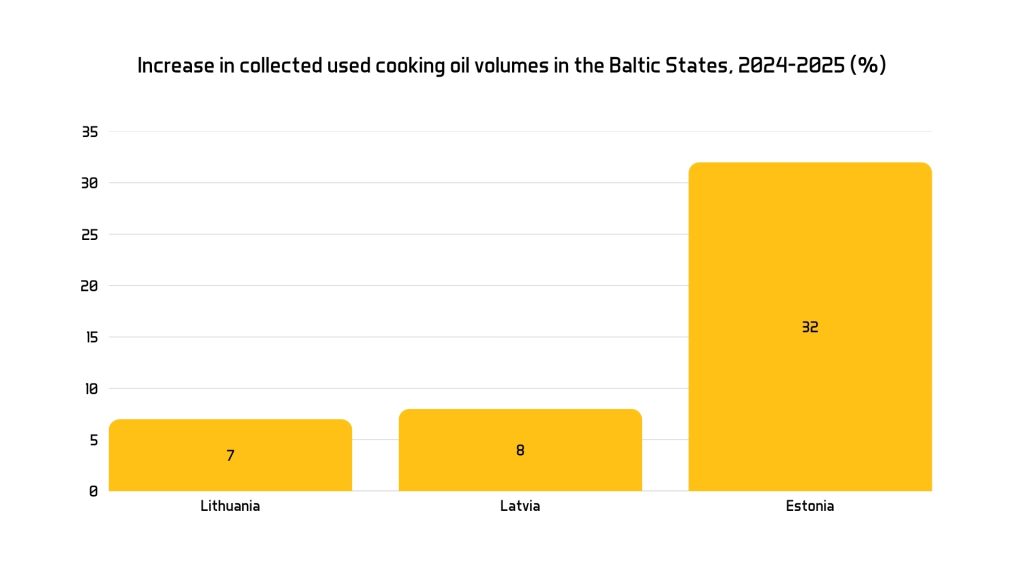
The fastest expansion, as before, was recorded in Estonia—where the market is still only taking shape. This shows that future growth lies not only in efficiency, but also in the development of new markets.
However, what matters most is not the percentages, but the system that works and grows together with clients.
Infrastructure that changes habits
During 2025, our collection network grew to 6,000 locations across the Baltic states. More than 500 new locations were added to the network, and in Lithuania 172 new oil collection containers were installed for residents (236 in total).
During 2025, Biomotorai processed more than 14,500 tonnes of food oil and fat waste, which were handed over to biofuel producers. It is estimated that this helps avoid tens of thousands of tonnes of CO₂ emissions, depending on how the feedstock is ultimately used.
Why do clients choose reliability?
D. Karanauskas emphasizes that growth was driven not only by the market. The biggest impact came from clear decisions:
- strengthening the client base
- closer cooperation with existing partners
- improving collection and processing processes
- expanding infrastructure for residents
“Years of experience have shown that what matters most to clients is not promises, but reliability and quality. For restaurants, cafés, and food manufacturers, it is critically important that processes run smoothly: oil is collected on time, logistics function without disruption, and no additional administrative burden is required. That is why Biomotorai positions itself not as a service provider, but as a long-term waste management partner,” says D. Karanauskas.
Today, reliability is not an advantage—it is a necessity.
Back to the list